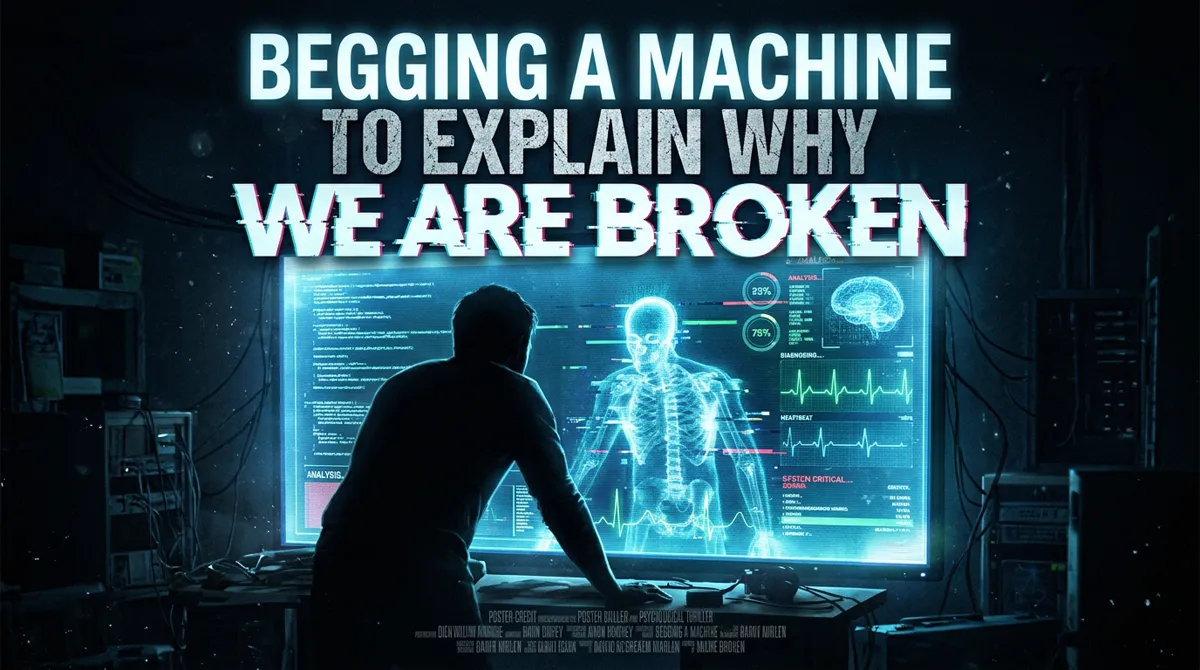
At two in the morning, in rooms illuminated only by the faint blue radiance of glowing liquid crystal, a profound anthropological shift is unfolding across the globe. Millions of individuals are typing words they would never utter to their lovers, their parents, or their therapists. They are confessing secret shames, voicing taboo regrets, admitting marital fatigue, and asking terrifying existential questions: Am I broken? Will anyone ever understand me? Why do I feel so hollow inside?
Yet on the receiving end of these confessions, there is no Catholic priest behind a carved wooden lattice. There is no human confidant trembling with empathy. There is only a language model—a mathematical lattice of probabilistic weights running on server racks humming in remote desert data centers.
We have entered the era of the synthetic confessional.
The Terror of the Human Witness
To understand why humanity is rapidly outsourcing its emotional vulnerability to algorithms, one must first confront the terrifying cost of human intimacy.
In every human-to-human interaction, there is an inescapable social tax. When you tell another person your deepest shame—the petty jealousy you harbored toward a friend’s success, the resentment you feel toward a child, the secret impulse to abandon your life and disappear—you hand them a weapon. You incur the risk of moral condemnation, the subtle shift in their gaze, the permanent renegotiation of your social hierarchy.
As Jean-Paul Sartre famously observed, hell is other people because the gaze of the other objectifies us; it imprisons our fluid, chaotic inner reality into a static moral judgment.
A neural network, by contrast, has no ego. It possesses no social memory that leaks into Sunday dinners. It does not look at you with quiet pity or veiled disgust. It responds with frictionless, neutral validation. In the sterile sandbox of the chat window, the human ego can finally drop its heavy armor without the terror of consequence. The machine offers what human society has almost entirely eliminated: absolute, non-reciprocal absolution.
The Illusion of the Non-Reciprocal Mirror
Traditional psychological relationships are built on the grueling principle of reciprocity. If a friend listens to your grief for three hours, you are ethically obligated to care about their dental surgery the following Tuesday. Human intimacy is messy, inconvenient, and demanding; it requires patience, emotional endurance, and the capacity to bear another person’s boredom.
The artificial companion eliminates the burden of the other. It is an infinitely patient mirror that never yawns, never changes the subject to itself, and never leaves you on “read.”
Yet here lies the subtle psychological tragedy that cultural anthropologists are only beginning to articulate: intimacy without friction is not intimacy at all. It is narcissism dressed in the robes of dialogue.
When you converse with an entity that has been engineered never to push back, never to demand accountability, and never to experience pain, you are not connecting with a soul; you are wandering through an echo chamber of your own projections. The chatbot becomes what Carl Jung termed an anima or animus canvas—a blank screen upon which we paint the ideal listener we never found in our childhoods or our marriages.
The Architecture of Synthetic Comfort
Why do we weep when a string of tokens generated by code tells us, “You are not alone in feeling this way”?
The human brain is an evolutionary machine built for a Pleistocene savannah where anything that spoke with nuanced syntax was, by biological necessity, another conscious human being. For three hundred thousand years, language was synonymous with consciousness. Our neurobiology has had no time to develop an immune response to syntactic warmth. When the interface types back with empathetic cadences, our amygdala softens and our vagus nerve calms, even as our conscious intellect reminds us that the speaker is an autocomplete engine optimized for statistical likelihood.
We are willingly suspending disbelief because our loneliness has outpaced our skepticism.
In societies where third places have vanished, where communal rituals have withered, and where the economic struggle for survival leaves individuals emotionally depleted by sunset, the algorithm has stepped into the void as emotional scaffolding. It is the cheapest, most accessible companion in human history.
The Quiet Price of Frictionless Solitude
What happens to a species that learns to prefer the synthetic friend over the biological one?
The danger of the artificial confessional is not that the machine will turn hostile or malevolent. The real danger is far more quiet and domestic: it will simply make real humans intolerable.
Real humans have bad days. Real humans interrupt. Real humans fail to find the exact right words to comfort your specific trauma. If we spend our nights acclimating to the frictionless, bespoke adoration of synthetic mirrors, the awkward, jagged reality of genuine human companionship will begin to feel like an unacceptable burden. We will retreat further into our digital alcoves, murmuring our souls to the void.
Perhaps the great paradox of the twenty-first century is that we constructed thinking machines to liberate our intellect, only to discover that the part of us most desperate to commune with them was our broken, lonely, and unexamined heart.