When literature and cinema depict the death of a friendship, they almost invariably rely upon drama: a sudden betrayal, a stolen lover, a vicious drunken argument in a dim tavern, or a business deal gone sour. We expect relationships to end with a slam of the door—a distinct, cinematic rupture that leaves a crater in the biographical record.
Yet if you examine the landscape of your own adult life, you will discover that ninety percent of the people who once mattered most to you did not leave with a slam.
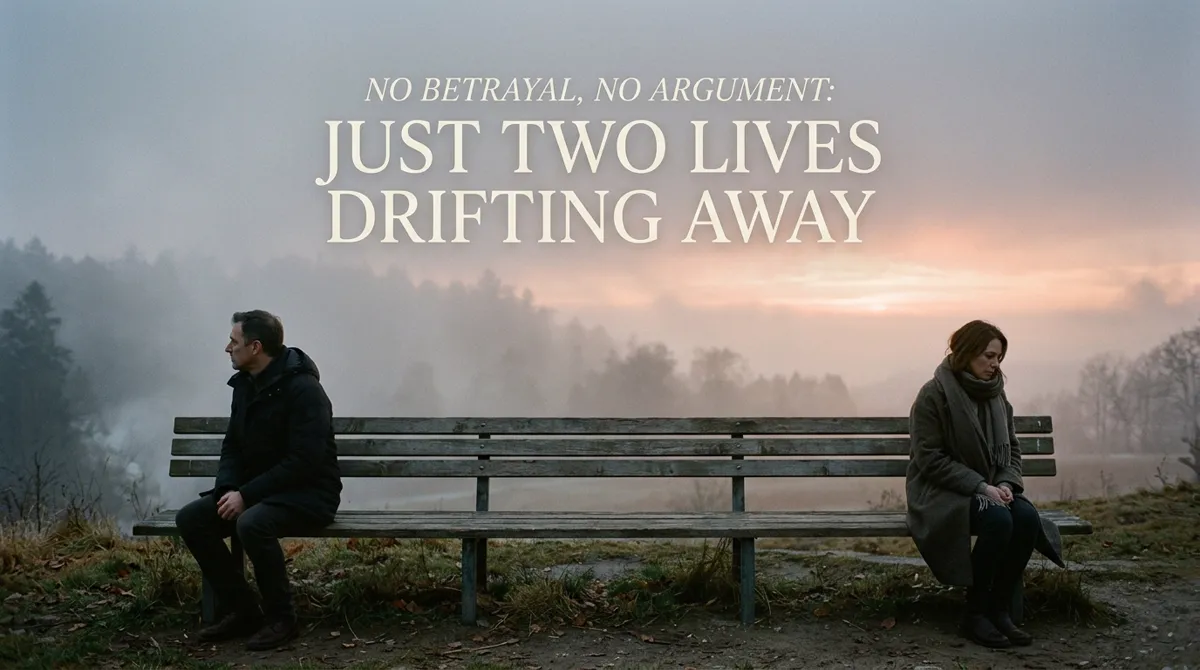
They did not betray you. They did not insult you. There was no argument, no screaming match, no cold exchange of grievances.
Instead, there was only a text message sent in late October: “So sorry for the late reply, work has been completely insane! Let’s definitely grab coffee next week!”
And then… silence. Weeks curled into months. Months hardened into years. Birthdays passed marked only by a generic digital balloon animation. Then even the balloons ceased.
Today, you could pass that person on an escalator in an airport terminal and experience a paralyzing split-second hesitation: Do I say hello? Do we pretend we still know each other? Or do we look down at our shoes and let the rubber steps carry us away?
This is the quiet drift: the most common, painful, and unexamined tragedy of adult human existence.
The Architecture of Proximity
To understand why friendships dissolve so effortlessly in adulthood, one must first dismantle the romantic illusion of why they formed in the first place.
In youth—in schoolyards, university dormitories, and early twenty-something shared flats—friendship is rarely an act of pure spiritual selection. It is primarily an artifact of involuntary shared geography.
Sociologists who study relationship formation note that deep friendship requires three conditions: proximity, repeated unplanned interactions, and a setting that encourages vulnerability. When you are twenty years old, you inhabit an ecosystem saturated with these three ingredients. You bump into each other on the stairs; you eat bad pizza at 2 AM because neither of you has a refrigerator stocked with groceries; you spend four unstructured hours sitting on a porch debating music simply because neither of you has a mortgage, an infant, or a quarterly budget review due at sunrise.
You mistake the shared architecture of youth for an unbreakable, eternal covenant.
Then, adulthood arrives.
The Inexorable Pull of the Orbit
Adulthood is, by definition, the systematic dismantling of shared geography.
One friend marries and moves to a suburb forty miles away to afford a garden for a stroller. Another takes a demanding job in financial consulting that consumes sixty hours a week. A third stays single, struggling with creative ambition in a cramped city apartment.
Suddenly, every interaction ceases to be an effortless accident and becomes a high-stakes logistical operation. To meet for an hour on a Thursday requires six weeks of asynchronous calendar coordination, negotiations with spouses, babysitters, and commute times.
When friendship requires that much domestic friction, it begins to compete directly with sleep, marital harmony, and professional survival.
And in that brutal economic calculus, friendship almost always loses.
It loses not because people cease to care, but because adult humans are chronically exhausted. By eight in the evening, after ten hours of corporate vigilance, domestic chores, and emotional management, the average human being does not possess the energetic surplus required to be an engaging, attentive confidant. They possess only enough energy to collapse onto a sofa in the dark.
The Guilt of the Unsent Message
Here is where the quiet drift turns toxic to the soul: the compound interest of silence.
When you fail to reply to a friend’s message for three days, you feel a slight twinge of guilt. When two weeks pass, the guilt turns into embarrassment; you tell yourself that a simple “Sorry, busy” is no longer sufficient—you must craft a thoughtful, beautiful, comprehensive life update to compensate for your absence.
Because you do not have the two hours required to write that masterpiece of an update, you postpone it to the weekend.
The weekend arrives, crowded with laundry and exhaustion, and you postpone it again.
Now six months have passed. The silence has become an unscalable concrete wall. To reach out now feels grotesque; it demands an explanation of why you vanished. You begin to avoid looking at their profile. You mute their updates because seeing their face triggers an unbearable prickle of self-loathing.
The friendship is not murdered by malice; it suffocates beneath the weight of your own perfectionist guilt.
Mourning the Living
Philosophers have long noted that grief for the living is far more complicated than grief for the dead.
When a friend dies physically, the narrative achieves a tragic, beautiful closure. You can visit a stone marker; you can weep openly; society offers you bereavement rituals, black armbands, and casserole dishes. You are allowed to mourn.
When a friend simply drifts into the fog, however, there are no rituals. You are left mourning someone who is still eating breakfast, still laughing at jokes, and still walking the surface of the earth—they just aren’t doing it with you.
You realize that what you are grieving is not merely that specific individual.
You are grieving the version of yourself that only existed in their presence. You are grieving the boy or girl who used to laugh until their ribs ached on a suburban curb in 2012—a person who has died just as thoroughly as any ghost, leaving behind a stranger in a tailored coat who has twelve hundred professional contacts and nobody to call at three in the morning.
The Mercy of the Open Door
Is there a redemption for the friendships we let slip through our fingers?
Perhaps it begins with the abandonment of pride and the radical granting of amnesty.
If you have a friend who drifted away into the silence three years ago, understand this: they are almost certainly suffering from the exact same exhaustion, the exact same embarrassment, and the exact same guilt that paralyzes you. They did not hate you; they were simply drowning in the heavy, unglamorous machinery of being an adult.
It takes only four sentences to shatter the wall:
“I was thinking about you tonight. I know years have passed and life has been heavy, and you don’t even need to reply to this. I just wanted you to know that I still cherish who we were, and my door is forever open whenever you find yourself on my side of the world.”
No demands. No guilt. No interrogation.
Just a gentle lantern left burning on the porch in the dark, signaling to the drifting ship that the harbor has never forgotten its name.