You are thirty-two years old. In your daily life, you are a capable, autonomous adult. You manage departmental budgets, navigate complex interpersonal conflicts at work, pay a mortgage, and make life-altering decisions without asking anyone for permission.
Yet, as you pull your rental car into your parents’ driveway for Thanksgiving, something strange happens to your posture. By the time you haul your duffel bag across the threshold and smell that familiar blend of roast turkey, floor wax, and childhood dust, a psychological time machine has been activated.
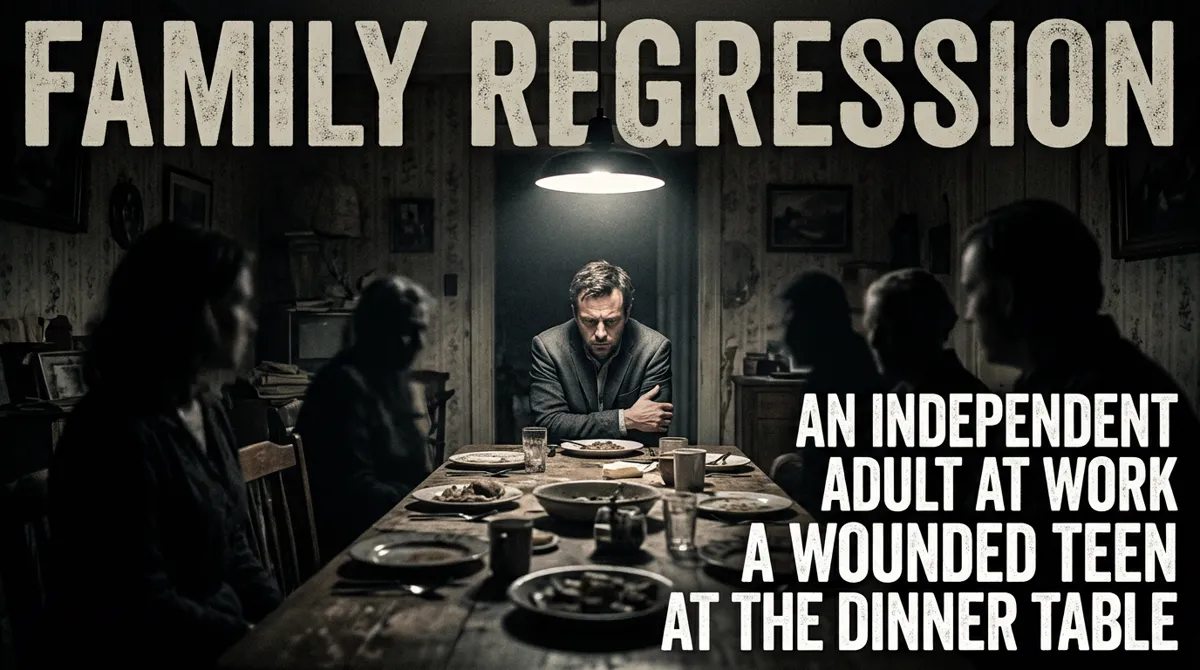
Within eight minutes, your mother asks you why you aren’t wearing a heavier jacket, your older brother interrupts you mid-sentence with a condescending chuckle, and suddenly you are slamming a kitchen cupboard, sulking on a hallway staircase, and furiously scrolling your phone in silent, adolescent fury.
Congratulations: you have just succumbed to Family Regression.
The Magnetic Pull of the Old System
Why does this happen with such terrifying, automated consistency?
In clinical psychology and Family Systems Theory, a biological family is understood not as a collection of isolated individuals, but as an interlocking emotional unit. Over decades of shared survival, the family develops a rigid equilibrium—what theorists call systemic homeostasis.
To maintain this delicate balance, every member was assigned (or subconsciously adopted) an archetype during childhood:
- The Golden Child (the mirror of parental pride)
- The Scapegoat (the depository for unspoken familial dysfunction)
- The Caretaker / Peacekeeper (the anxious mediator of disputes)
- The Invisible Child (the quiet one who takes up zero emotional space)
When you left home at eighteen or twenty-two, you spent years building an adult ego outside that system. You grew new emotional muscles; you discovered boundaries; you crafted a mature, nuanced persona in the wider world.
However, the family system does not know—or care about—your adult identity. When you return home for the holidays, the system’s homeostatic gravity exerts an overwhelming pressure to force you back into your childhood coordinate. Your parents and siblings do not relate to the person you became yesterday; they relate to the role you played when you were twelve.
The Somatic Hallway: Reliving Unprocessed Memory
The family home is not just physical real estate; it is a museum of somatic triggers.
Your brain’s hippocampus and amygdala have coded every sensory cue in that house:
- The distinct acoustic rhythm of your father’s footsteps descending the stairs.
- The subtle, passive-aggressive pitch in your mother’s voice when she asks if you want a second helping.
- The texture of the carpet in your old bedroom where you used to sit during emotional storms.
When you cross that threshold, your rational prefrontal cortex—the seat of your mature adult self—is quietly bypassed. Your nervous system recognizes the environmental cues that once required hyper-vigilance or submission, and it automatically deploys the exact defensive strategies that kept you safe twenty years ago.
You roll your eyes. You cross your arms. You become defensive. Your vocabulary shrinks. You are not choosing to act like a teenager; your body has hijacked your consciousness, convinced that you are once again trapped in a dynamic where your voice does not matter.
The Agony of the Un-Seen Self
The deepest tragedy of holiday family visits is the profound ache of invalidation.
We carry a silent, irrational hope every November: Maybe this year they will finally see me. Maybe this year my parents will recognize my maturity, ask me about my philosophical convictions, or acknowledge the wisdom I have fought so hard to cultivate.
Instead, you are handed a potato peeler and asked why you haven’t settled down yet, or why you cut your hair that way.
The pain you feel is the acute sorrow of an adult whose hard-won evolution is completely erased in the eyes of the people who gave them life. Being treated like a child when you have survived adulthood is a form of subtle psychological violence—not necessarily born of malice, but of your parents’ inability to accept that their authority has expired and their child is a stranger they no longer control.
The Armor of Adult Sovereignty
How do you survive the family gauntlet without detonating the Thanksgiving dinner table or collapsing into adolescent despair?
- Recognize the Script: The moment you feel that hot, defensive spike in your chest, mentally step outside yourself. Silently say: “The system is attempting to cast me in my old role. I do not have to accept the script.”
- Break the Physical Trance: Do not spend seventy-two continuous hours trapped inside the childhood house. Rent a hotel room or an Airbnb nearby. Have a rental car so you are never a captive passenger. Take long solitary walks in the cold whenever the atmospheric pressure inside the living room spikes.
- Surrender the Need for Their Validation: Your parents may never see the fully formed adult you have become. Accepting this reality is the final, agonizing milestone of true emotional maturity. You do not need their audit to confirm that your life is legitimate.
When you walk into their kitchen this holiday season, remember who you are when you are not in their house. You are no longer trapped in that hallway. The front door is unlocked, and your car keys are in your pocket.