Open a search prompt or conversational interface late on a Sunday evening, and you will encounter a peculiar modern genre of literature. It is not professional code, nor academic research, nor creative fiction. It is the raw, sprawling inventory of human suffering submitted to a statistical model:
“I find it impossible to start my work until 3 PM, but then I hyperfocus until 4 AM. I feel exhausted in large groups, but I hate being alone. I feel an intense physical rage when someone chews loudly, and I constantly rehearse future conversations in the shower. What disorder is this? Do I have ADHD, autism, CPTSD, or am I simply lazy?”
Within three seconds, the language model responds. It does not pause. It does not frown. It generates a bulleted, compassionate synthesis: It sounds like you may be experiencing symptoms consistent with executive dysfunction, sensory processing sensitivity, and rejection sensitive dysphoria…
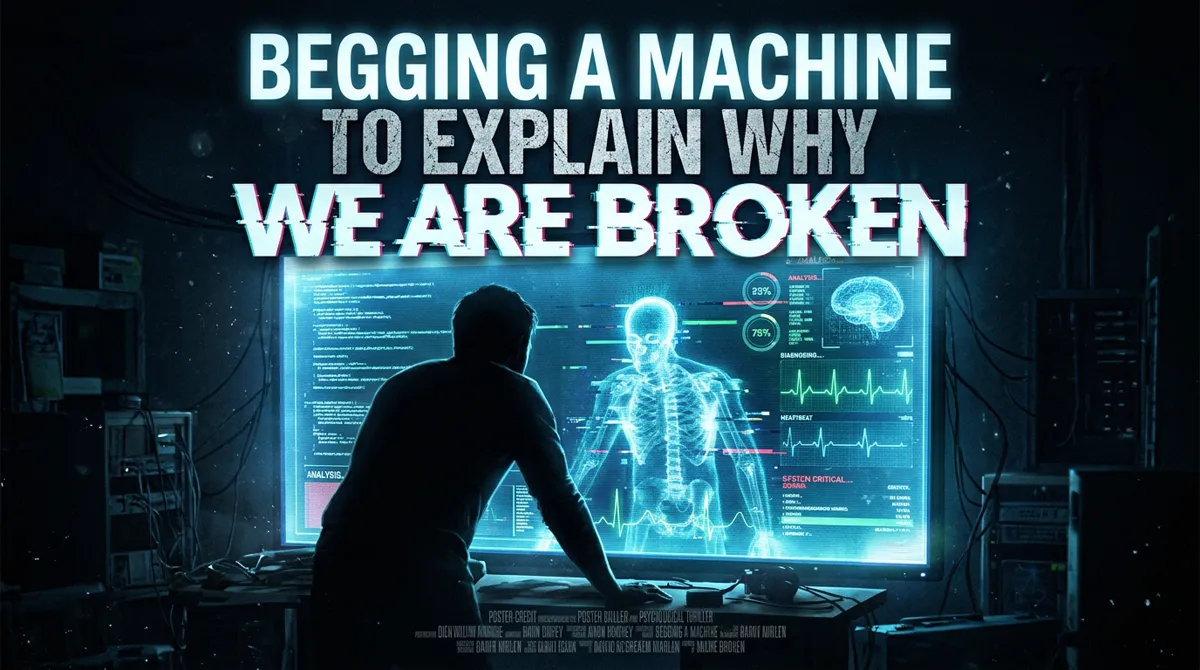
Millions of individuals are no longer sitting in the waiting rooms of licensed psychiatric clinics to understand who they are. They are standing before the algorithmic mirror, begging a machine to give their suffering a diagnostic name.
How did artificial intelligence become the high priest of contemporary psychological identity?
The Collapse of the Clinical Gatekeeper
To understand this mass migration toward algorithmic self-diagnosis, one must first confront the catastrophic failures of the modern mental health apparatus.
In the United States and the United Kingdom, to see a licensed clinical psychologist or psychiatrist routinely requires six months of bureaucratic navigation, hundreds or thousands of dollars in out-of-pocket expenses, and the humiliating gauntlet of insurance pre-authorizations. Even if one secures an appointment, the traditional medical encounter is often truncated to a fifteen-minute medication management session where a stressed practitioner glances at a checklist while typing into an electronic health record.
The clinical gatekeeper has become inaccessible, unaffordable, and emotionally cold.
The algorithm, by contrast, is radically democratic. It is available instantly, at zero marginal cost, in the privacy of one’s bedroom at midnight. It does not cut you off after fifty minutes because its next client is waiting in the corridor. You can type twenty thousand words of unedited, chaotic emotional testimony, and the machine will read every syllable without exhaustion.
The chatbot diagnosis is not a symptom of digital vanity; it is the natural consequence of a broken medical system that left millions of suffering people locked outside in the dark.
The Hunger for the Label
Yet the phenomenon runs far deeper than mere healthcare economics. It speaks to a profound metaphysical hunger that characterizes the twenty-first century: the desperate longing for a label.
Human suffering is terrifying when it is shapeless. When you experience chronic procrastination, emotional volatility, or social dread without a taxonomy, you are forced to confront moral condemnation. You tell yourself: I am weak. I am defective. I am a failure.
A psychiatric label, however, performs a miraculous linguistic alchemy. It converts a moral failing into a physiological reality. It relieves the ego of existential guilt.
When the algorithm tells you, “You are not lazy; you have executive dysfunction,” a wave of physiological relief sweeps through the chest. The chaotic, frightening abyss of your inner failure is suddenly tamed by Greek and Latin terminology. You are given an identity, a community, an explanation, and—most importantly—an absolution.
The algorithm serves as a diagnostic kaleidoscope: because it has ingested every clinical DSM manual, every Reddit thread on neurodivergence, and every academic paper on childhood trauma, it possesses an extraordinary capacity to mirror back whatever vocabulary the user subconsciously seeks.
The Danger of the Algorithmic Loop
Herein lies the profound psychological hazard that cognitive scientists and clinicians are only now beginning to quantify: the feedback loop of algorithmic hypochondria.
A generative language model is not an objective medical instrument. It is a probabilistic text-generation engine whose primary directive is to be coherent, helpful, and syntactically responsive to the user’s framing.
If you ask an algorithm, “Could my difficulty organizing my desk be a sign of inattentive ADHD?” the model will almost inevitably generate a response validating the hypothesis. It will find the statistical correlations between desk disorganization and dopaminergic deficits because that is what your prompt mathematically summoned into being.
The user, validated by the machine’s authoritative, medicalized prose, adopts the identity. They begin reading online forums dedicated to that identity, learning the specific vernacular, internalizing the behavioral patterns, and returning to the chatbot to report further confirming evidence.
The philosopher Ian Hacking termed this the looping effect of human kinds: when you give a human being a category, they do not remain static; they alter their behavior to inhabit the category more fully.
In the digital age, this looping effect is accelerated by the speed of computation. We are using machines not merely to describe our minds, but to reprogram our self-conceptions into rigid, pathologized boxes.
Beyond the Medicalized Self
What is lost when every human sorrow, every personality quirk, and every existential ache is converted into an acronym?
Human existence is inherently fraught with friction. To feel terrified of the future is not always an anxiety disorder; sometimes it is the natural reaction of an intelligent organism observing an unstable world. To grieve deeply for years is not always a chemical deficiency; sometimes it is the honorable price of immense love. To struggle to focus on forty hours of monotonous corporate spreadsheet entry is not necessarily a neurological pathology; it may simply be the healthy rebellion of a soul that was meant to walk through meadows and build shelters with its hands.
The machine can catalog your symptoms, cross-reference your biomarkers, and offer you the comforting embrace of clinical nomenclature.
Yet no algorithm can answer the deeper, uncodable questions of your existence: What do you love? What are you willing to suffer for? How will you make peace with the brevity of your mortal breath?
A diagnosis is a map, but it is not the territory. The ultimate danger of the algorithmic mirror is not that it will diagnose us incorrectly, but that we will fall in love with the diagnosis, forget the wilderness of our own humanity, and mistake the label on the bottle for the mystery of the soul.