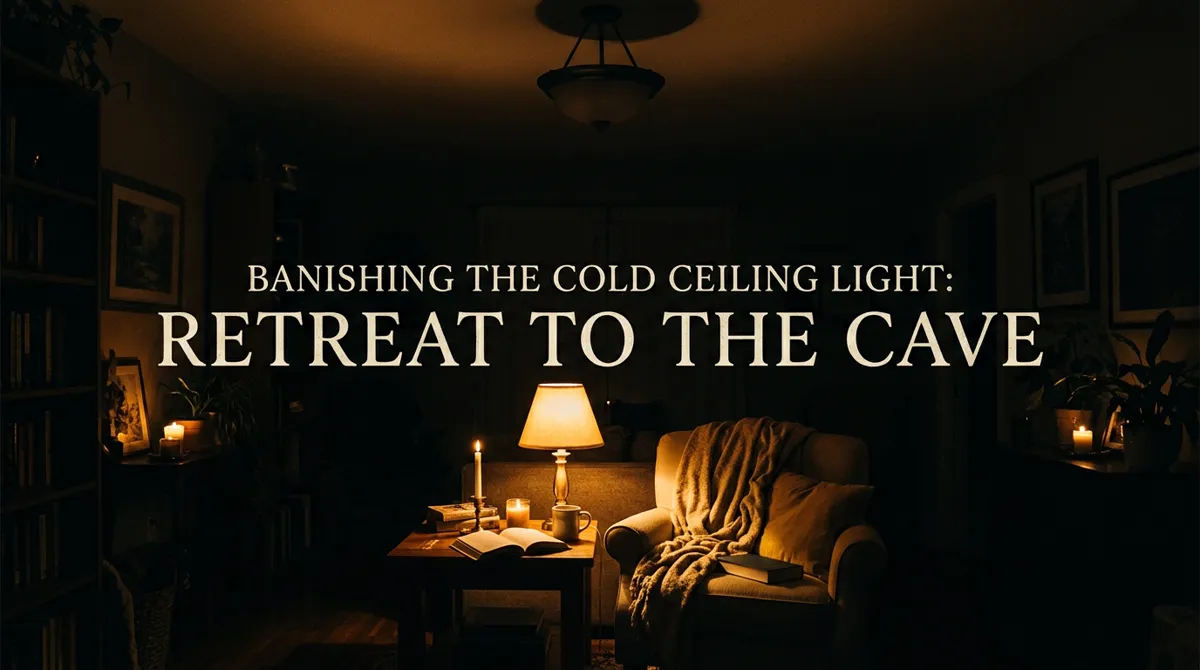
Enter almost any home shared by younger adults after sundown, and you will witness an unspoken domestic sacrament: someone reaching for the wall switch, flicking off the central ceiling fixture, and illuminating a corner table lamp bathed in deep amber.
“Please,” someone will invariably murmur from the sofa, “not the Big Light.”
What began as a viral internet meme across social feeds has quietly revealed itself to be a legitimate cultural revolt. The phrase “The Big Light” has become shorthand for everything clinical, aggressive, and dehumanizing about modern architectural lighting. To sit under an overhead fluorescent bulb in your own living room feels less like relaxing and more like waiting for an interrogation or a minor surgical procedure.
Conversely, the retreat into low-wattage, warm amber pools of light is not just aesthetic preference—it is a desperate psychological sanctuary built against a world that refuses to soften its edges.
The Anatomy of the Interrogation Ceiling
Why do overhead white lights evoke such visceral discomfort?
The answer is rooted in our evolutionary wiring. For hundreds of thousands of years, high-intensity light emanating directly from overhead meant one thing: the midday sun. It was the hour of highest exposure, maximum heat, and peak alertness—the time when predators were visible and physical exertion was at its height.
Overhead light carries an inherent psychological weight of surveillance. When a room is bathed in uniform, shadowless 5000K white light, nothing can hide. Every flaw in the plaster, every crumb on the carpet, every tired crease beneath your eyes is violently leveled into public view. The architecture of the room loses its depth, collapsing into the flat, sterile geometry of a hospital corridor, an Amazon fulfillment center, or a police precinct.
When you switch on the Big Light after a ten-hour day of staring at LED screens, you are asking your nervous system to remain perpetually exposed. You are refusing your psyche a shadowy corner in which to curl up and let down its social armor.
The Chiaroscuro of Safety: Why Amber Heals
Consider the psychological properties of a single low-level amber lamp:
- The Architecture of Intimacy: A small pool of warm light creates an island in the dark. It delineates a boundary: Here, within this gentle halo, you exist. Outside this halo, the rest of the world dissolves. Shadows are not our enemy; they are the velvety curtains that screen out the clutter of the room and the noise of our obligations.
- The Primordial Hearth: Human beings spent ninety-nine percent of their history ending their days beside firelight (approximately 1800K to 2200K on the Kelvin color temperature scale). Amber light carries zero blue frequencies. It tells the pineal gland that the hunt is over, the territory is secured, and no further labor will be demanded of the organism tonight.
- The Softening of Thought: Under harsh white light, thoughts become brittle, transactional, and urgent. Under amber illumination, cognitive cadence slows. The voice softens. Conversations shift from logistic updates to confessions.
The Rebellion Against Institutional Glare
The cultural obsession with ambient lighting—fairy lights, salt lamps, Edison bulbs, vintage brass desk lamps—is a symbolic reclamation of autonomy.
Modern life takes place almost entirely within institutional lighting that we cannot control. You sit under unrelenting fluorescent tubes in the office, you commute beneath glaring LED highway pylons, you grocery shop through aisles of blinding supermarket glare. Every public space is engineered to maximize visibility, surveillance, and consumption.
Turning off the Big Light when you cross your own threshold is the only moment of the day when you assert sovereignty over your sensory reality. It is a quiet declaration: Here, I am not an employee. I am not a consumer. I am an animal resting in its den.
Designing the Shadows
To live well at night, one must learn to design not with light, but with shadow.
A room with no shadows is a room with no soul. When you banish the Big Light, you allow the contours of your space to breathe. You create pockets of mystery, corners where the mind can wander without being assaulted by high-contrast clarity.
Tonight, when you return to your room, resist the mechanical reflex to hit the main wall switch. Leave the ceiling dark. Let an amber lamp cut a quiet gold circle onto your desk or floor. Step inside that circle, sit in the stillness, and listen to how quickly your exhausted mind exhales when the glare of the world is finally extinguished.