Consider the king of France in the seventeenth century. He possessed Versailles, a hundred cooks, the finest silks of the Levant, and chamber musicians waiting upon his command. Yet to hear a string quartet, musicians had to tune physical wood and horsehair; to taste strawberries, he had to wait for the brief French summer; to receive news from Rome, a courier had to ride three horses into exhaustion over dusty Alpine passes.
Even the absolute monarch of the Western world lived within an architecture of natural scarcity.
Today, an adolescent sitting in a basement in Ohio or Ankara possesses sensory luxuries that would have baffled Louis XIV. With a twitch of a thumb, they can summon four million musical symphonies, feast upon endless libraries of high-definition cinema, order warm Thai noodles to their doorstep in thirty minutes, and scroll through thousands of hyper-stimulating micro-dramas engineered by five hundred software engineers with PhDs in behavioral neuroscience.
Yet if you ask this modern citizen how they feel, the answer is rarely ecstasy. It is, almost universally, a flat, dry, restless numbness.
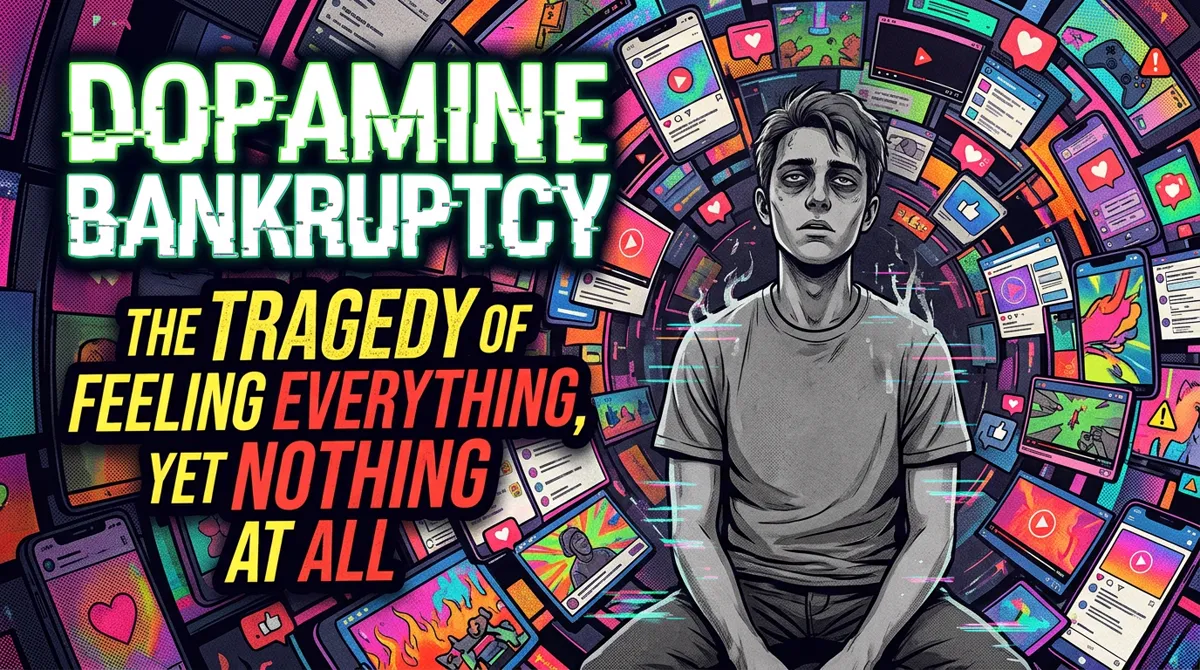
We are not suffering from sensory deprivation. We are experiencing dopamine bankruptcy.
The Misunderstood Molecule
To grasp the pathology of the modern spirit, one must dismantle the cultural myth surrounding dopamine. Pop psychology often portrays dopamine as the molecule of pleasure—a warm chemical hug released when you eat a warm pastry or win a game.
In neurobiology, dopamine is not the molecule of satisfaction; it is the molecule of pursuit. It is the neurochemical engine of more.
Dopamine evolved to motivate an ancestral primate to climb the tallest tree for a single fig, or to track an antelope across fifty kilometers of arid plains. It produces the prickle of anticipation, the focused craving, the urge to look under the next rock. Critically, dopamine is programmed to plummet the instant the reward is seized, generating a brief wave of dissatisfaction designed to prevent the organism from becoming complacently extinct.
In an evolutionary environment characterized by severe energetic scarcity, this mechanism was a masterpiece of survival engineering.
In a digital landscape of infinite, frictionless abundance, it is an engine of psychological torment.
The Hedonic Treadmill on Overdrive
When you scroll through a vertical video feed, your brain is subjected to an artificial dopamine lottery. Each swipe is a pull of a digital slot machine: boring video, funny video, outrage video, beautiful body, geopolitical crisis, absurdity. The unpredictability supercharges the dopamine surge, locking the prefrontal cortex into an automated loop of seeking without ever arriving.
Neurologists know that the brain maintains homeostasis through receptor downregulation. When flooded with unnatural, industrial quantities of dopamine, the neurons protect themselves by retreating—they pull their receptor sites inward, becoming less sensitive to subsequent signals.
This is the biological foundation of tolerance.
The video that made you laugh aloud three months ago now elicits merely a hollow stare. The music that once made your spine shiver becomes background noise. You require stronger stimulants, weirder content, and sharper emotional jolts simply to achieve the baseline neutrality that your ancestors experienced while sitting quietly beneath an oak tree.
This state is what clinicians term anhedonia—not the presence of acute sorrow, but the eerie absence of emotional resonance. You can stare at the most exquisite sunset on earth and feel only a detached, intellectual awareness that it is theoretically pretty, while your thumb aches to check whether someone in another hemisphere left a comment on your post.
The Exhaustion of the Wanting Self
The philosopher Arthur Schopenhauer anticipated this neurochemical trap two centuries before the invention of the smartphone. He argued that human life swings like a pendulum between pain and boredom. When we lack what we desire, we suffer the torment of craving; when our desires are instantly satisfied, we are crushed by the dead weight of ennui.
In the twenty-first century, we eliminated the pendulum. By compressing the gap between desire and fulfillment to zero, we trapped the psyche in a state of permanent, restless appetite.
We are exhausted because our wanting circuitry never sleeps. Even when lying in bed, the mind is quietly hunting: checking delivery trackers, refreshing subscriber counts, scanning headlines for catastrophe. The soul is never allowed to inhabit the verb to be; it is permanently conscripted into the frantic service of to acquire.
The Sacred Art of Voluntary Deprivation
How does one file for bankruptcy and emerge solvent?
The answer cannot be found in more sophisticated stimulation. You cannot cure dopamine depletion by downloading a mindfulness app that gamifies your breathing with gold badges and digital fireworks.
The only cure for receptor exhaustion is the voluntary re-embrace of emptiness.
It is what ancient spiritual traditions recognized under the austere titles of fasting, silence, and sabbath. When you deliberately deny yourself sensory stimulation—when you turn off the phone for forty-eight hours, sit in an unadorned room, eat simple bread without watching a documentary, and allow yourself to experience the prickly, uncomfortable terror of pure boredom—a quiet miracle occurs in the synapses.
The exhausted receptors begin to slowly emerge from their bunkers. The baseline resets.
Suddenly, the world reclaims its lost texture. The taste of a plain green apple becomes an extraordinary, sharp revelation. The sound of rain beating against a tin roof feels rich with poetic resonance. A conversation with an old friend, unmediated by glass, carries the weight of authentic human warmth.
We do not need more wonders to awaken our souls; we have drowned in wonders until our senses went blind. We need only the silence and the hunger to remember how to feel them again.