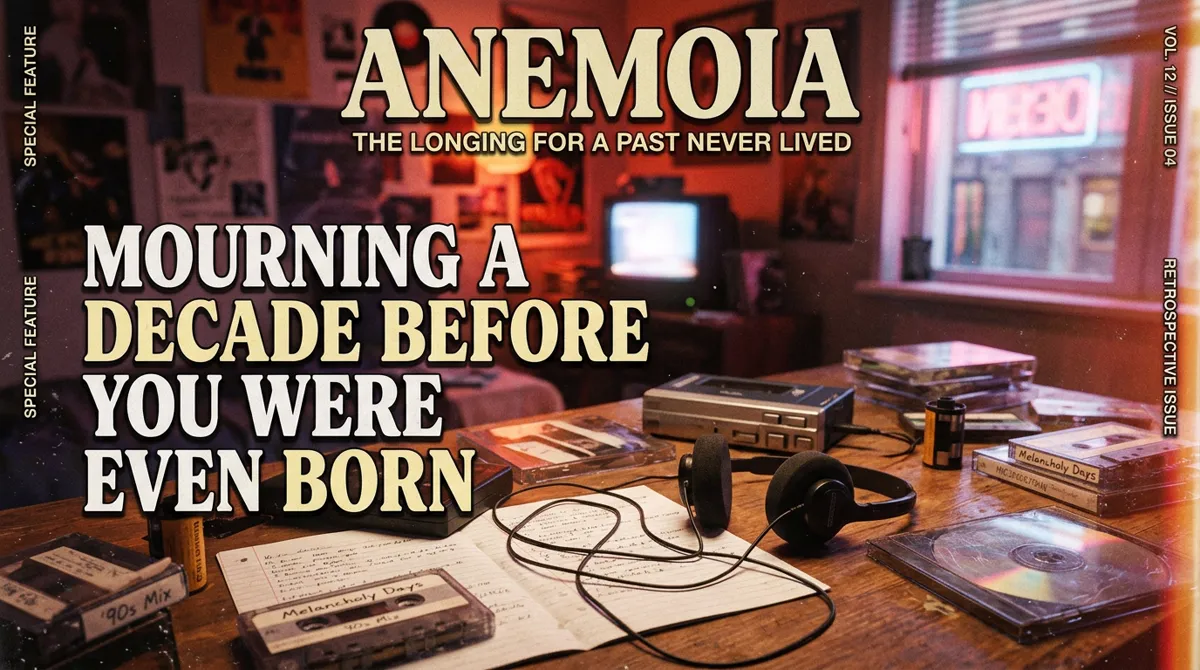
In John Koenig’s poetic compendium The Dictionary of Obscure Sorrows, there appears a neologism that captures one of the most pervasive, haunting psychological states of our era: Anemoia—nostalgia for a time you have never lived.
Walk into a café in Portland, Shoreditch, or Kadıköy, and you will witness an extraordinary anthropological ritual. An eighteen-year-old born in the year 2008 sits at a table, rewinding a magnetic cassette tape with a pencil. In their pocket rests a grainy 2-megapixel digital camera manufactured in 2003. They are listening to lo-fi city pop recorded in Tokyo in 1984, wearing an oversized flannel shirt reminiscent of a 1993 Seattle garage band, while discussing the aesthetic warmth of 1970s Polaroid film.
This is not simple historical curiosity; it is a visceral, aching homesickness.
How does one mourn a decade whose air they never breathed? Why does a generation raised in the most technologically supreme epoch in human history feel a phantom grief for the analog world they arrived too late to touch?
The Phantom Memory of Scarcity
Nostalgia, in its classical medical formulation by the Swiss physician Johannes Hofer in 1688, was considered a physical disease—a lethal homesickness (nostos meaning homecoming, algos meaning pain) experienced by soldiers stationed in foreign lands, who pined for their Alpine valleys so violently that their hearts failed.
Classical nostalgia, however, always required an autobiographical memory: you mourned the kitchen where your grandmother baked bread, the schoolyard where you scraped your knees, the lover who broke your heart in your youth.
Anemoia breaks the causal chain of memory. It is a phantom limb of the soul.
To understand why the digital generation suffers from this phantom ache, one must look closely at what the present lacks. The modern world is characterized by hyper-definition, instant archiving, and total surveillance. Every moment is recorded in 4K resolution, instantly uploaded to cloud servers, audited by metrics, and permanently fixed in digital amber. Nothing is lost; therefore, nothing can be discovered.
The analog eras—the 1970s, 80s, and 90s—represent something that no longer exists on earth: the texture of unmonitored human time.
When an eighteen-year-old looks at a sun-faded 35mm photograph of teenagers laughing in a suburban parking lot in 1987, their soul is not responding to the denim jackets or the hairstyle. Their soul is responding to the radical, terrifying freedom visible in their eyes: no one in that photograph has a phone in their pocket. No one is curating the moment for an invisible audience. They are entirely, terrifyingly present.
The Warmth of Physical Decay
Digital media does not age; it merely corrupts. An MP3 file does not develop a gentle hiss; a JPEG does not take on the sepia warmth of an old attic; an algorithm does not gather dust. Digital files exist in a state of clinical, timeless sterility—infinite copies, forever identical, forever cold.
Physical matter, however, participates in mortality.
When you slide a vinyl record onto a turntable, the needle rides through physical canyons of polyvinyl chloride. The subtle pops and crackles are the auditory sound of time itself brushing against matter. When a cassette tape warps in the heat of a car dashboard, the pitch gently wobbles, giving the voice an eerie, fragile vulnerability.
The youth who hoard cassettes, vinyl, and disposable cameras are not rejecting modern technology out of Luddite spite; they are starving for physical consequence. They are drawn to objects that possess a body—things that can be scratched, dropped, lost, and loved.
They are reacting against an existence where culture has become a frictionless stream of disembodied electric currents that leave no trace in the palm of the hand.
The Mirage of the Pre-Internet Eden
There is, of course, a romantic delusion embedded at the heart of anemoia.
The past was never the golden, sun-drenched sanctuary preserved in archival grain. The 1970s were choked with industrial smog, political terror, and leaded gasoline; the 1980s were haunted by Cold War nuclear dread; the 1990s were rife with suburban boredom and isolation. If you transport a modern teenager back to a rain-soaked Tuesday in 1983 without an internet connection, they would likely spend five hours staring at a wallpaper pattern in mind-numbing agony.
Yet historical reality is irrelevant to the architecture of myth.
Myth does not describe the past as it was; it describes what the present desperately needs. Anemoia is a subconscious critique of contemporary exhaustion. When the soul imagines the pre-digital era, it imagines a world where human attention had not yet been harvested by multinational behavioral algorithms. It imagines a world where boredom was allowed to ferment into poetry, where a phone call was an event, and where you could genuinely disappear into an afternoon without the world demanding your coordinates.
Grieving the Unlived Horizon
Perhaps the deepest melancholy of anemoia lies in the realization of the irrevocable.
Every generation leaves behind a world that cannot be re-entered. But previous generations left behind worlds whose physical ruins remained: Roman aqueducts, medieval stone walls, Victorian train stations. You can still stand inside a Gothic cathedral and feel the sacred shadows of the twelfth century.
The analog world of the late twentieth century, however, was demolished not by stone and mortar, but by code. It vanished with breathtaking speed into the palm of our hand.
To feel anemoia is to sit in the quiet light of a smartphone screen, watching old video clips of strangers in a mall in 1994, and realizing that what you are mourning is not their mall, their clothes, or their music.
You are mourning the death of innocence. You are grieving the lost paradise of human unreachability—the quiet, sacred era when the world was vast, mysterious, and gloriously unindexed.